
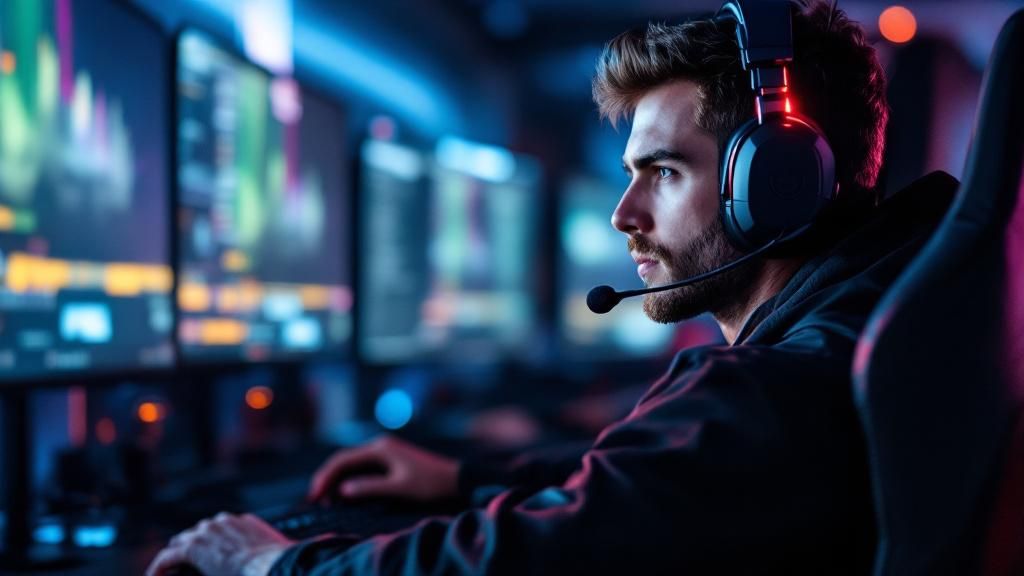
Whether you’re engaging in esports tournaments or chasing victory in intense multiplayer competitions, your gaming hardware can be the deciding factor between triumph and defeat. This professional guide reveals the essential upgrades that dedicated players require to excel in their discipline, from advanced graphics cards and lightning-fast processors to high-quality peripherals and high-refresh monitors. Discover how selecting appropriate hardware can sharpen your competitive edge, lower latency, and ultimately enhance your overall gameplay to championship-winning levels.
GPU Upgrades
The graphics processing unit (GPU) serves as the foundation of competitive gaming performance, substantially affecting frame rates and picture quality throughout competitive play. Contemporary esports titles demand GPUs able to produce sustained high fps at competitive resolutions, typically 1440p and above. Opting for a top-tier graphics card from companies including NVIDIA or AMD ensures you maintain the performance advantage essential for instant responses and enhanced game awareness during crucial gameplay moments.
Frame rate stability remains absolutely vital in competitive scenarios where every millisecond counts significantly. A high-performance graphics card decreases frame drops and stuttering, delivering smooth, uninterrupted gameplay that enables you to react instantly to opponent movements. Modern graphics cards featuring advanced cooling solutions and overclocking capabilities deliver the thermal headroom necessary for consistent performance during prolonged gaming sessions, stopping thermal throttling that could damage your competitive edge.
Ray tracing technology, although visually striking, remains less important than raw performance in competitive gaming environments. Dedicated competitors typically turn off ray tracing to boost frame rates, prioritising speed over graphical fidelity. Instead, concentrate on choosing GPUs with considerable memory capacity, ideally 10GB or more, maintaining smooth operation across demanding titles without VRAM constraints that could damage your competitive edge.
The resolution and refresh rate combination you target directly determines the GPU specifications you’ll require for peak performance. Competitive players pursuing 1440p gaming at 240Hz need significantly more powerful hardware than those targeting 144Hz at the same resolution. Grasping these performance limits enables you to select the appropriate GPU tier, guaranteeing your spending matches precisely with your particular esports goals and ambitions.
NVIDIA’s latest RTX 40-series and AMD’s RDFS 7000-series graphics cards showcase the pinnacle of competitive gaming performance, offering exceptional frame rates across nearly all current esports games. These premium options boast advanced features including DLSS 3 technology and FSR 3 support, which effectively improve performance without diminishing visual quality. Investing in high-end GPUs provides extended lifespan, confirming your hardware remains competitive for an extended period of rigorous esports competition.
Budget-conscious gamers shouldn’t worry, as mid-range GPUs from both manufacturers provide excellent value for money for competitive gaming. Cards like NVIDIA’s RTX 4070 or AMD’s RX 7800 XT provide outstanding performance at reasonable price points, making fast-paced esports play accessible without excessive spending. These sensible choices combine gaming demands with budget constraints, allowing dedicated competitors to upgrade their systems responsibly.
Central Processing Unit and Memory Enhancement
CPU Selection for Competitive Gaming
The central processing unit serves as the backbone of your gaming system, handling a wide range of game logic to physics calculations and machine learning processes. For competitive play, you’ll want a processor that can delivering consistent frame rates whilst preserving low latency. Contemporary multi-threaded processors from Intel and AMD offer superior computing power, with higher core counts enabling better performance during resource-heavy tasks. Investing in a quality processor ensures your system won’t become a limiting factor, allowing your GPU to perform at its full potential and keeping you competitive.
When choosing your processor, evaluate models purpose-built for gaming workloads rather than server-focused chips. The latest generation processors feature better instructions per clock and superior heat management, meaning superior responsiveness without overheating issues. Clock speeds between 4.5 and 5.5 GHz are ideal for most competitive titles, providing the speed needed for split-second decision-making. Ensure your selected processor complements your motherboard and heat dissipation system to maintain peak performance throughout prolonged play sessions.
RAM Configuration and Speed
Memory bandwidth proves vital in competitive gaming performance, significantly impacting how quickly your processor can retrieve the data it needs. Modern competitive games benefit significantly with 32GB of RAM, offering plenty of capacity for simultaneous applications and background processes. Opt for DDR5 or DDR4 memory with speeds of 3600MHz and above, as quicker RAM reduces latency and enhances frame stability. Two-channel setup is critical, meaning you should fit memory modules in matched pairs to maximise bandwidth and deliver peak performance across all gaming scenarios.
Beyond capacity and speed, focus on low-latency CAS ratings, generally ranging from 14 to 18 for high-performance builds. RGB lighting serves purely aesthetic purposes and shouldn’t influence your purchasing decision; concentrate on dependability and performance data. Reputable manufacturers with robust warranty coverage provide peace of mind for your investment. Correct memory installation in the appropriate memory slots, paired with appropriate BIOS settings, maximises the capabilities of your memory configuration and makes a significant contribution to your overall competitive advantage.
Thermal Management and Operational Stability
Efficient cooling significantly influences your processor’s ability to maintain consistent performance during intense competitive matches. Premium air cooling solutions or liquid cooling solutions avoid thermal throttling, which occurs when processors reduce clock speeds to manage excessive heat. Opting for premium cooling guarantees your CPU runs at optimal temperatures, typically between 60 and 75 degrees Celsius during gaming. Adequate air circulation within your case, paired with quality thermal paste application, optimises heat dissipation and maintains the stability necessary for competitive gameplay.
System reliability becomes paramount when milliseconds decide victory or defeat in high-stakes competition. Overclocking can deliver marginal performance gains, but only when approached cautiously with proper thermal management and voltage control. Consistent oversight of thermal levels and system performance through stress testing prevents unexpected crashes during crucial matches. Quality power supplies with adequate power reserves ensure consistent voltage delivery to your components, removing sources of instability. Favour reliability over aggressive overclocking to maintain reliable performance when it matters most.
External Hardware and Screen Technology
Gaming Mice and Keyboards
A high-accuracy gaming mouse is critical for success in competition, notably in intense shooter titles and strategy-based gaming. Look for mice featuring customisable sensitivity levels, remappable controls, and light construction that facilitate rapid, accurate movements without exhaustion. Premium producers offer responsive detection technology, confirming your clicks register instantaneously. Mechanical keyboards provide enhanced response times versus rubber dome options, with programmable actuation allowing you to tailor actuation force and key depth. These input devices significantly affect your response speed and overall gameplay consistency, making them sound purchases for serious competitors.
Ergonomic design should always be considered when selecting gaming equipment, as extended competitive play require comfort alongside performance. High-quality mice and keyboards reduce strain injuries and maintain your accuracy during lengthy competitive events. Proper cable management and wireless connectivity options provide adaptability in your gaming setup, though wired options generally deliver marginally lower latency. Configuration software allows you to programme macros and adjust sensitivity profiles for various titles. Premium peripherals may appear costly at first, but their longevity and performance benefits warrant the expense for serious competitive players looking for dependable, consistent gear.
Monitor Specifications and Refresh Rate Performance
Display technology constitutes one of the most essential components for esports performance, significantly affecting your visual feedback and reaction capabilities. Monitors with elevated refresh rates, spanning 144Hz to 360Hz, provide considerably more fluid gameplay in contrast with standard 60Hz displays. Lower input lag means you perceive enemy movements with greater precision, offering vital fractions of a second for tactical decisions. Resolution factors must weigh image sharpness with frame rates; whilst 1440p delivers excellent detail, 1080p at higher refresh rates often suits esports competition more effectively. IPS panels provide superior colour accuracy, though TN panels conventionally provided faster response times, though contemporary IPS solutions has narrowed this gap considerably.
Response time, expressed as milliseconds, significantly influences how rapidly your monitor renders updated frames, minimising ghosting and motion blur during intense gameplay. Aim for monitors offering 1ms or faster response times for peak competitive performance. Adaptive sync technologies like FreeSync and G-Sync eliminate screen tearing and stuttering, creating seamless visual experiences that enhance your competitive advantage. Curved displays can enhance immersion and decrease eye strain during marathon gaming sessions. When selecting your monitor, prioritise refresh rate and response time over resolution, as these factors have a greater effect on competitive performance than pixel density alone.
Sound Gear and Headphones
Competitive gaming demands exceptional audio clarity, as sound cues often determine victory or defeat in tactical shooters and team-based games. High-quality gaming headsets provide accurate directional sound, allowing you to pinpoint enemy locations through footsteps and gunfire. Low-latency wireless technology guarantees audio synchronization with visual action, eliminating distracting delays. Surround sound capabilities, whether virtual or authentic 7.1 configurations, provide spatial awareness that significantly enhances gaming performance. Noise-cancelling features allow you to focus by removing background noise, whilst soft cushioning ensures you can use headphones during long competitive play without strain or exhaustion.
Microphone quality is equally important for competitive team gaming, where clear communication shapes tactical success. Look for headsets equipped with noise-cancellation technology that removes ambient sound, allowing teammates to understand your communications clearly. Flexible or detachable microphone booms facilitate ideal placement for pristine voice clarity. Professional-grade audio components ensure your team obtains premium sound quality during pivotal moments. Committing to dedicated gaming audio equipment rather than cost-cutting options reflects commitment to competitive excellence, improving your own performance alongside your team’s coordination, communication, and overall effectiveness during competitive tournaments.
